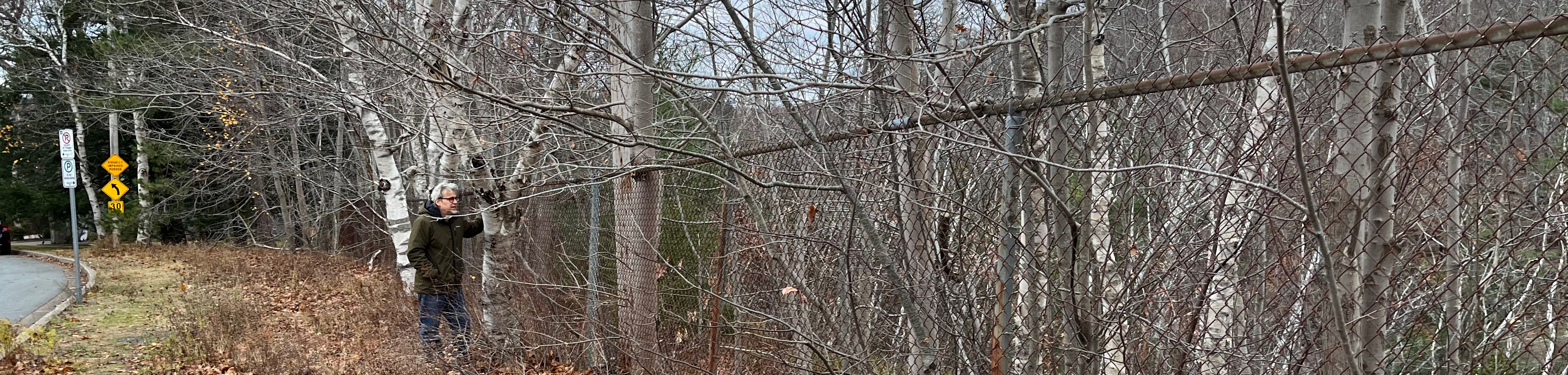

Naturalized front yard ©J. Lundholm
I just spent several hours weeding my naturalized front yard. It’s probably time to explain this project. In 2008, we’d had enough of paying for oil to heat our house. We decided to put in a geothermal heat pump to replace the oil furnace. This method of heating a house is more efficient than oil, natural gas and air-source heat pumps, taking advantage of the constant temperature deep underground (~11 degrees C, regardless of the season). But there’s a large upfront cost and it took us about 10 years to break even on this. Installing the heat pump system involved a large drill rig driving on to our postage stamp front yard (probably 8 m x 8 m) and drilling two 200′ deep boreholes in the where the plumbing to run the heat pump would be contained. The massive truck created huge ruts in the lawn. What we did not realize is that the material in the boreholes would need to go somewhere. This amounted to a whole lot of grey ground rock slurry that poured out of a hose onto our front yard and adjacent properties. I’m going to guess it was 100 square meters of 10 cm deep grey goo. Luckily, I was working at home that morning and was able to intervene with a snow shovel to prevent the neighbour’s garage from being flooded by grey mud. The combination of a very heavy drill rig parked right on our front lawn which churned up the soil and the rock slurry that now covered most of the lawn motivated me to get rid of the lawn altogether and begin naturalizing the front yard. It was basically a moonscape, and re-sodding this with lawn grass was the last thing this ecologist was prepared to do.
We knew a landscape architect who put together a rough design for us. I wanted native plants, and the original design was to create several different habitats: a raingarden was put in a depression that captured the runoff from a single downspout draining the front half of the house roof. Wetland and riparian species like blue flag iris, sweet fern and red osier dogwood would go there. There was also an “upland” planted with shrubs common to forest edges and barrens (bayberry, tall cranberry, wild raisin, virginia rose, bush honeysuckle), and some wetland edge shrubs like winterberry and rhodora along the border of the raingarden’s elliptical depression. The winterberry provides a hit of bright colour in the dead of winter with its persistent berries that the birds seem to slowly pick away at.

Winterberry (Ilex verticillata). ©J. Lundholm.
We also ripped up a section of our paved driveway and created a strip of “barrens” in the sunniest spot in the whole yard. We repurposed some of the pavement by burying it under the soil to create a shallow substrate for barrens species which specialize on thin dry soils. We also ordered some large local rocks as landscape features. As it turns out, the contractor was unable to source local material; the rocks delivered were limestone blocks from the Niagara Escarpment in Ontario! Instead of rejecting these in favour of a redesign, and since the Niagara Escarpment is close to my heart[1], we kept them. A couple of the flat-topped blocks make convenient seats, tucked away between tall bayberry shrubs making for a peaceful refuge when the leaves are out. The bayberry releases a sweet scent from its leaves, which I harvest in the fall to make a refreshing beverage.

Winterberry (Ilex verticillata). ©J. Lundholm.
As I write this 18 years down the road, much has changed in our front yard; the original design is scarcely evident. The place is fully covered with plants and these fall into three main categories. The first is the plants that were originally planted in 2008. These were mostly shrubs and ferns; many of which are still extant in the yard (Christmas fern, interrupted, cinnamon, crested wood fern); the herbaceous plants in the rain garden including the iris and sweet flag have largely disappeared, replaced by more generalist forest edge species. This makes sense as a rain garden’s function is to channel runoff and rapidly infiltrate this water downward into the soil. Apparently, our rain garden was very efficient at getting rid of the surface water, resulting in conditions too dry for the wetland plants, leading to further homogenization of our front yard flora (the upland plants that took over merely spread from the adjacent areas: asters, goldenrods, bush honeysuckle). Some of the upland shrubs didn’t last either: the sheep laurel was mainly on the strip of land between the sidewalk and the street. Owned by the city, homeowners are responsible for maintaining these narrow strips of mostly lawn. The sheep laurel finally died out only a few years ago after surviving at least ten. I’m not really sure what happened to it as our closest forest, on the plateau on either side of the railway cut, is full of sheep laurel in the understory. One of the main issues is probably the massive Norway maple that overshadows all, a street tree with a one-metre diameter trunk and the designation “TRE621024”[2]. Another factor might have been the human foot traffic: people would park adjacent to the narrow strip and walk across to get to the sidewalk. In snowy winters, the area also became a snow dump when we could find nowhere else to put it after shoveling. The other main shrubs planted included bayberry, bush honeysuckle, wild raisin, highbush cranberry and wild rose. Of these, bayberry did extremely well and now forms a subcanopy along with a set of birch trees (see Class 2 below) below the Norway maple. And the rest are largely still present in their original spots.

Bayberry (Morella pensylvanica)L, Meadowsweet (Spiraea alba) C; Paper birch (Betula papyrifera) ©J. Lundholm
The second group of plants comprise the spontaneous native species. In most cases, I have discovered populations of these in nearby habitats not too far from our place so it’s not surprising that they have seeded in on their own. Hay-scented fern, which predictably, I love for its scent, has established in a couple of places. Two sweetfern plants came in on their own, in sight of their likely parents less than 50 meters away in a dry, rocky, sun-blasted gap in the scrubby forest that girds the railroad cut. This is not actually a fern but a shrub, with foliage reminiscent of fern leaves. A relative of the bayberry, the sweetfern didn’t make it past five years, likely due to lack of sunlight (this species is typically found in areas with full sun exposure). For some of the volunteer natives, especially trees and shrubs like paper birch and serviceberry, when I discovered the seedlings in random places in the yard, dropped by the wind or bird poop, I transplanted them into locations more suited to the overall aesthetics and emerging “design”. Other natives include horsetail that seems to be everywhere now; a juniper shrub, which adds to the burgeoning complement of prickly or thorn-bearing shrubs (Virginia rose, I’m looking at you)[3]. After transplanting, I’ll typically remove some of the surrounding vegetation to give the seedlings a chance. Just small tweaks, these plants are tough. There were many paper birch seedlings that established in the yard in the early days and I decided to create a row of birches along the northwest side of the yard.

Paper birch (Betula papyrifera) ©J. Lundholm
As for the serviceberry, this tall shrub or short tree is one of the great unsung plants of my city: a profusion of white blooms in May when there is little else flowering. I was very excited to have these join the front yard flora but it took until this year for the first one to flower (probably 10 years after transplanting). Again, I’m blaming the shade cast by our street tree.
The third category of plants were transplanted into the yard from other places. Some of these came from nearby semi-natural habitats, like the railroad cut, but also surplus plants from our green roof experiments conducted at the university just down the street. Only a handful of these species remain (poverty oatgrass Danthonia spicata, wavy hairgrass Avenella flexuosa), but some of the most successful include blue-eyed grass and harebell, although the latter has declined in the past few years. Many of my favourite barrens species did well initially but disappeared after 3–4 years: crowberry, mountain cranberry, roseroot, seaside plantain. The seaside plantain and roseroot I planted immediately adjacent to the driveway, where I expected the salt we use in winter to create conditions similar to the coastal rocklands where these species typically hang out. One salt tolerant species I introduced is still thriving there: the seaside goldenrod, with its thick basal leaves and large chrome yellow flower clusters. Of the many barrens species I planted, lowbush blueberry and black huckleberry are two that have survived and thrived, with a larger berry crop each year. Other transplants came in with my friend and colleague Tyler, a sedge expert who planted a handful of Carex species into the yard; almost all are still present. I’ve got a list somewhere…

Lowbush blueberry (Vaccinium angustifolium) (white flowers), black huckleberry (Gaylussacia baccata) (red flowers) ©J. Lundholm
In the beginning, I was assiduous about removing any non-native plant I found. These included remnants of the lawn grass that originally covered the site, but also lots of weeds that seeded in. 18 years farther on, I now only concentrate on the most invasive species: the maple seedlings, multiflora rose, privet and European black ash. I tolerate what I consider more benign introductions such as common hawkweed and coltsfoot.
At one point, probably only 4–5 years after the initial planting I conducted a plant inventory and found over 100 species across this tiny space. Now, almost 20 years after we installed the heat pump, it’s certainly less than 50 species. I learned a few things from all this. First, my attempt to create distinct vegetation types relied on the maintenance of distinct environments preferred by the different plant species. This made sense in theory[4], but several factors pushed my yard toward homogeneity. First there was the overwhelming influence of shade from overhead; the sunniest parts are not that different from the shadiest parts. Then there was the outstanding performance of the raingarden, rendering the wetland not wet enough, and not really distinct enough to prevent the generalist shrubs and herbs from taking over.
The plants themselves changed the environment, also in the direction of homogenizing the soil conditions. One of the reasons for planting a variety of natives was to heal the soil after the addition of all that rock slurry. The plants built up the organic content of the soil and increased its depth over time, resulting in a richer soil over the whole area. My attempt to create a harsh, shallow, dry barren was ultimately undone by the plants that built up a more fertile soil layer over the buried pavement slabs and the indomitable action of plant roots to penetrate between the slabs and find the hidden soil layers underneath. Essentially, I tried to make a harsh setting for plant growth and the plants themselves made it more benign. Consequently, the generalists (mainly asters and goldenrods) have largely taken over. There’s also the issue of scale. My yard may simply be too small to maintain such distinct environments, especially given that many of the plants that cover the site now spread by underground rhizomes, likely subsidized by parent plants in more optimal locations still attached to the new recruits.

Downspout end of the raingarden in 2026 ©J. Lundholm
It also became apparent that this tiny ecosystem is connected to others in our neighbourhood. First, there is two-way seed traffic between adjacent habitats and our yard. There is a constant rain of seeds from the street trees and neighbours’ yards (mainly Norway and sycamore maple; these two species account for the majority of my work in the yard these days). Birds also bring unwanted species, especially multiflora rose. On the other hand, I have been overjoyed to see that some of the native herbaceous plants (white goldenrod and pussytoes) I established in the yard have now spread to other nearby habitats, mainly in the wild areas adjacent to the railroad cut (not in my neighbours’ yards). These species were likely here before the city, so I’m making a tiny contribution to restoring some of the original biodiversity that would have been here (this is what I tell myself in any case). Some others are spreading more locally: blue-eyed grass is establishing in sidewalk cracks just a few centimeters from where I originally planted the parents.

Blue-eyed grass (Sisyrinchium montanum) established in a sidewalk crack. ©J. Lundholm
The place is also connected to other local ecosystems through the animals that visit. Song sparrows once used the poverty oat grass I had planted in the yard to make a nest in one of my bayberry shrubs. There’s not much of that species growing locally besides the ones I planted in the yard and it’s an obvious identification: the old leaves remain attached to the base of the plant and curl in circles, unlike any other local grass, so I’m claiming that the yard provides distinct nesting resources for birds. Bees, butterflies and hoverflies all visit the flowering plants, starting in mid-summer when the wild roses and bush honeysuckle are blooming (bees especially love the latter). But it’s in the fall that the yard seems to provide the most benefit for pollinators due to the preponderance of asters and goldenrods that have taken over by September. A graduate student studying urban pollinators even found a rare bumblebee species visiting plants in our yard at one point. There are also resident red-backed salamanders and shrews, and lots of birds come and go.

New York aster (Symphyotrichum novi-belgii) in fall. ©J. Lundholm
After hours of pulling maple seedlings on my hands and knees, I ask myself why I bother with all of this. I restored what now most closely resembles a native forest-edge habitat, it has many of the same species as the forest edge adjacent to the railroad cut. The species are mainly generalists that are found throughout the region, so I haven’t created high quality habitat for rare species. It does provide resources for pollinators, but so do my neighbours’ yards that are filled with a diversity of non-native flowers. It stores more carbon than a lawn but the net effect would be tiny owing to the small footprint of the site. The plants did heal the soil, which now looks like the typical dense clay-loam common to the Halifax peninsula, but the main benefit is probably just personal. As someone who works on ecological restoration and urban greening, I get frustrated by the many political and economic barriers that work against those who are trying to restore and rewild Nova Scotia’s native ecosystems. I suppose I just wanted a place where I could do this work myself without any of those barriers. Getting out there and weeding this garden puts me closer to the soil. This activity keeps my mind active, maintaining the botanist’s skill of identifying small seedlings based on subtle differences in hue and texture, and all in the service of a tangible goal: removing all the invasive maple seedlings (a goal Sisyphus would perhaps recognize).

Black huckleberry (Gaylussacia baccata) in fall ©J. Lundholm
I guess in the end, my front yard is really just a different kind of garden, but certainly one co-designed by nature. With the original landscape design now almost two decades in the past, the main input I provide now reminds me of the sculptor who creates an elephant by painstakingly chipping away everything that does not look like an elephant. By removing the most egregious of the non-natives, what remains is a wild place, a hybrid space not entirely a native habitat but very far from a manicured lawn.
[1] I did my PhD research on limestone barrens (pavements) associated with the Niagara Escarpment on the beautiful Bruce Peninsula in Ontario.
[2] See the wonderful Halifax Public tree map: https://justbartek.ca/hfxtrees/
[3] We really have too many of these shrubs, but they seem to keep the deer away. Unfortunately, the deer just eat the neighbours’ tulips instead! To be clear, this was never part of the plan.
[4] In very general terms, this was my PhD research topic.

Leave a Reply