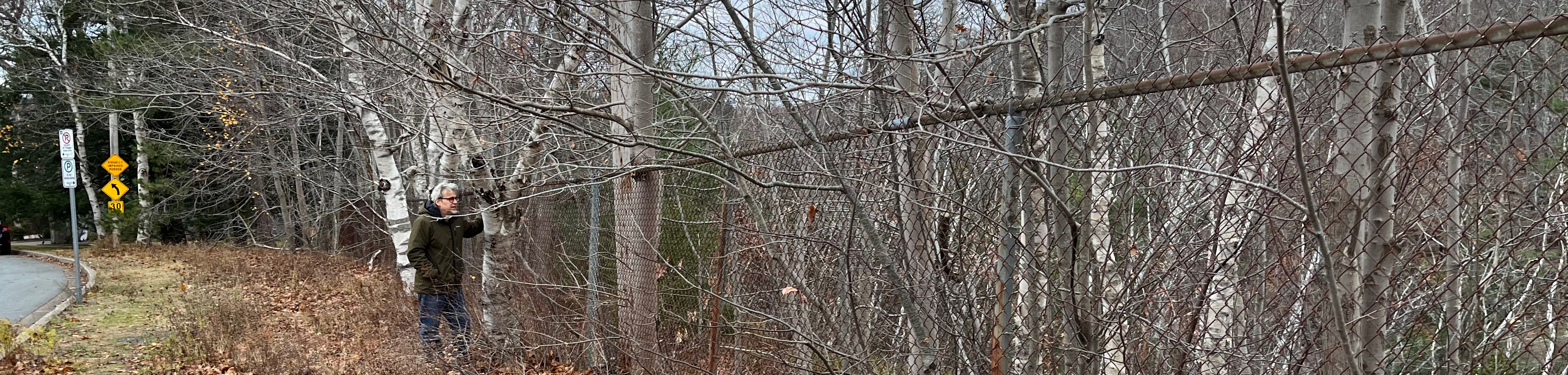

What my backyard wants to be ©J. Lundholm
I was an ecologist before I ever started gardening. It was in the mid 1990s, and I’d finished my undergraduate degree in biology where I focused on ecology and plants. As an environmentalist, I was learning about the importance of local food. This is also when I started really getting into cooking, so I wanted to grow my own food. As an aspiring botanist, I was also interested in native plants, especially their use in ecological restoration, back then in southern Ontario. My first vegetable and herb garden came together at the same time I converted the front yard of our rental place into a tiny native prairie.

My postage stamp prairie, Hamilton, Ontario ©J. Lundholm
From the ecological approach to bringing damaged land back to health, there were general principles that I absorbed in my studies and later through projects that restored native vegetation. Diversity is good! The native plants I’ve been studying since that time live in mixed communities often with mosses and symbiotic lichens, but also an entire biome of life living in the soil in and around the plant roots. Most natural areas feature hundreds of plant species, and I had been taught the dangers of monoculture farming, so I was drawn to gardening techniques that promoted biodiversity. As an idealistic environmental studies graduate student, my journey involved the “discovery” of classic texts, such as Masanobu Fukuoka’s The One-Straw Revolution, as much a philosophy as a treatise on farming techniques. Fukuoka’s practice, refined over decades, eschewed disturbing the soil, removing weeds and other typical practices of conventional gardening in favour of letting nature take its course: no tilling, no monoculture, no pesticides. My earliest attempts at food gardening were not quite so radical (we tilled!), and met with some success, especially in community garden plots with great soil and full sun, in the hot summer of Hamilton, Ontario, assisted by my partner who had as much gardening experience as me but a whole lot more common sense. I didn’t realize then that my gardening journey would only go downhill after that.
Moving to Halifax in 2004, I enthusiastically started a vegetable garden by digging up part of our lawn. The soil was clayey and full of rocks and there was only partial sun due to tall trees all around. My seasonal schedule involved putting a lot of work into preparing the soil and planting in the spring, and then becoming busy with field work as the summer wore on, ignoring weeds in the garden, and finally, lamenting my pathetic harvest in the fall. I went easy on the weeds, telling myself that plants like to have neighbours of different species (native plants, after all, typically live in mixed-species communities). Some of my human neighbours are outstanding gardeners, despite the maritime climate I found perplexing (“What do you mean the trees aren’t fully leafed out until June?”). Seeing and tasting the beautiful produce my neighbours grew was humbling and forced me to reexamine my approach to growing plants.

Common ragweed (Ambrosia artemisiifolia) ©J. Lundholm
Ultimately, I couldn’t shake the ecological paradigm that had become second nature to my every thought. What emerged is an attempt to understand my gardening failures through an ecological lens. Looking at the history of vegetable domestication, many of the species I was trying to grow are annuals (or biennials or short-lived perennials) that evolved a specific strategy before humans ever attempted farming: they grow in areas where the soil has been recently disturbed[1]. In natural settings, disturbances take the form of landslides or treefalls, basically any event that removes existing vegetation and exposes bare soil. These areas tend to have ample light and nutrients because potential competitors have been removed by the antecedent disturbance. This is why most garden vegetables don’t like shade. The annual lifestyle involves growing quickly, before other plants show up, and reproducing (flowering, fruiting and making seeds) before dying and leaving seeds for the next generation.
My backyard wants to be a forest; it was forested before the city was developed but I also know this because tree seedlings rapidly establish if we don’t mow the lawn. Trees will quickly create shade at ground level. Putting in a garden requires human intervention to create the optimal conditions for vegetables: removing competitors that would cast shade and compete with the garden plants for water and nutrients. While the importance of competition in natural plant communities has been challenged in recent decades, and I was very influenced by the idea of plants growing in mixed communities, the ecological reality is that garden plants are not the same as the native plants that would have grown in my backyard when it was still a forest understory. Ecology lesson for me: know the evolutionary history of what you are trying to grow and the conditions your plants require. Any gardener would have passed on the fundamental message: “weed your garden!”. But I was stubborn and arrogant; I thought that ecology was a better worldview to approach gardening. I don’t think this is incorrect, but as it turned out, I had much more to learn about ecology, and my teachers came from an unexpected group of plants.
[1] Ecologists call these species “ruderals”, from a Latin word meaning “rubble”; other people call these species weeds.

Leave a Reply